Usage credit electricity plans are some of the most eye-catching offers in Texas, often showing a surprisingly low average price at exactly 1,000 kWh or 2,000 kWh. The catch is that these plans only deliver that exact price when your home lands on an exact usage target each month. Hit that number, and you earn a bill credit that reduces your total cost. If you don’t hit the specified minimum usage, the credit disappears, which can make your bill jump.
Because the advertised “best” rate is calculated with that credit included, it rarely reflects what most households actually pay. That is why understanding how usage credit plans work, how to read the Electricity Facts Label (EFL), and how your home typically uses electricity is essential before you sign up. In this guide, we break down how usage credit plans work, who they’re best for, and how to compare them so you avoid costly surprises on your bill.
A usage credit electricity plan gives you a fixed dollar credit on your bill — often $50, $75, or $100 — only when your monthly usage hits an exact kilowatt-hour (kWh) target, such as 1,000 kWh. The credit applies once per billing cycle and is not a discount on your per-kWh rate. Instead, it lowers your effective cost at that specific usage point. If your home uses even slightly below the target, the credit does not apply, and your total bill can be significantly higher.
These plans are a type of fixed-rate plan with a usage-based bill credit layered on top. Their advertised “low” rate reflects hitting the exact target, not what most homes pay month-to-month.
The plans below are for a specific area. To see the plans in your area please enter your zip code.
| Provider | Plan | ¢/kWh | Est. Monthly Bill | Term | Checkout Link |
|---|---|---|---|---|---|
| Companion Energy | Companion Savings + Benefits 12 | 7.6¢ | $76 | 12 months | Checkout |
| Octopus Energy | Octopus Lite 12 | 7.7¢ | $76.5 | 12 months | Checkout |
| Energy Texas | The Lone Saver 15 | 7.7¢ | $76.6 | 15 months | Checkout |
| 4Change Energy | Maxx Saver Value 24 | 7.7¢ | $77 | 24 months | Checkout |
| Express Energy | Flash Value 24 | 7.7¢ | $77 | 24 months | Checkout |
| Frontier Utilities | Frontier Saver Plus 24 | 8.0¢ | $80 | 24 months | Checkout |
| Gexa Energy | Gexa Eco Saver Plus 24 | 8.0¢ | $80 | 24 months | Checkout |
| APG&E | SimpleSaver 24 | 8.4¢ | $84 | 24 months | Checkout |
| Veteran Energy | Valor 12 | 13.4¢ | $134 | 12 months | Checkout |
| Rhythm Energy | Watt a Deal 12 | 18.7¢ | $186.8 | 12 months | Checkout |
In Texas’s deregulated electricity market, Retail Electric Providers (REPs) set your plan’s pricing structure, while Transmission and Distribution Utilities (TDUs) like Oncor, CenterPoint, AEP, or TNMP handle the physical delivery of power. REPs often create electricity plans that reward customers who consistently use a certain amount of electricity with a usage or bill credit.
A usage credit plan starts with a standard energy rate (in ¢/kWh) plus your TDU delivery charges. The defining feature is the bill credit that applies only when your monthly usage reaches a specific kWh threshold, such as 1,000 kWh. This single credit amount (the bill credit) creates a wide tiered pricing structure for your EFL, where your cost at the target level is much lower than at other usage levels.
Here’s a simple example similar to what you’ll see on many Texas EFLs:
The “sweet spot” is the target of monthly usage where your bill credit applies and your effective rate is lowest. If your usage falls outside that target, even by just a small amount, you could lose the credit. Seasonal changes play a big role in this, as higher summer air conditioning use or lower winter electricity needs can push you above or below the credit band from month to month. Use your historical average usage to gauge how cost-effective a bill credit plan would be for your household.
This energy plan shows exactly how a usage credit creates a price difference depending on whether you hit the target.
Using the EFL averages:
| Energy Usage | Base Charge | Price/kWh | Bill Credit | TDU Delivery Charge (per month) | TDU Delivery Charge Per kWh | Effective Rate |
|---|---|---|---|---|---|---|
| 100 | 0 | 0.144 | 0 | $4.90 | 0.059027 | $0.252 |
| 200 | 0 | 0.144 | 0 | $4.90 | 0.059027 | $0.228 |
| 300 | 0 | 0.144 | 0 | $4.90 | 0.059027 | $0.219 |
| 400 | 0 | 0.144 | 0 | $4.90 | 0.059027 | $0.215 |
| 500 | 0 | 0.144 | 0 | $4.90 | 0.059027 | $0.213 |
| 600 | 0 | 0.144 | 0 | $4.90 | 0.059027 | $0.211 |
| 700 | 0 | 0.144 | 0 | $4.90 | 0.059027 | $0.210 |
| 800 | 0 | 0.144 | 0 | $4.90 | 0.059027 | $0.209 |
| 900 | 0 | 0.144 | 0 | $4.90 | 0.059027 | $0.208 |
| 1000 | 0 | 0.144 | $75.00 | $4.90 | 0.059027 | $0.133 |
| 1100 | 0 | 0.144 | $75.00 | $4.90 | 0.059027 | $0.139 |
| 1200 | 0 | 0.144 | $75.00 | $4.90 | 0.059027 | $0.145 |
| 1300 | 0 | 0.144 | $75.00 | $4.90 | 0.059027 | $0.149 |
| 1400 | 0 | 0.144 | $75.00 | $4.90 | 0.059027 | $0.153 |
| 1500 | 0 | 0.144 | $75.00 | $4.90 | 0.059027 | $0.156 |
| 1600 | 0 | 0.144 | $75.00 | $4.90 | 0.059027 | $0.159 |
| 1700 | 0 | 0.144 | $75.00 | $4.90 | 0.059027 | $0.162 |
| 1800 | 0 | 0.144 | $75.00 | $4.90 | 0.059027 | $0.164 |
| 1900 | 0 | 0.144 | $75.00 | $4.90 | 0.059027 | $0.166 |
| 2000 | 0 | 0.144 | $75.00 | $4.90 | 0.059027 | $0.168 |
| 2100 | 0 | 0.144 | $75.00 | $4.90 | 0.059027 | $0.170 |
| 2200 | 0 | 0.144 | $75.00 | $4.90 | 0.059027 | $0.171 |
| 2300 | 0 | 0.144 | $75.00 | $4.90 | 0.059027 | $0.173 |
| 2400 | 0 | 0.144 | $75.00 | $4.90 | 0.059027 | $0.174 |
| 2500 | 0 | 0.144 | $75.00 | $4.90 | 0.059027 | $0.175 |
When comparing electricity plans in Texas, the choice often comes down to simplicity versus potential savings. Traditional fixed-rate plans keep pricing straightforward, while usage credit plans add a layer of complexity that can reward specific households with lower costs.
Simplicity vs Potential Savings
A fixed-rate plan charges the same price per kWh every month, plus standard TDU delivery fees, making it easier to estimate your bill. A usage credit plan adds a conditional reward, offering a lower effective rate when your monthly usage falls within a defined usage target. This setup can reduce costs for consistent users, but it can also make bills harder to predict if your energy use fluctuates.
Usage-based electricity plans can be a smart choice for some Texas households, but only if your energy habits align with the plan’s structure. These plans reward consistency and penalize fluctuation, so it’s essential to know how much power you typically use before signing up.
Families or households that consistently fall within the 1,000–2,000 kWh range (depending on the plan) are most likely to benefit. This often includes larger apartments and mid to large-sized homes. The key factor is consistency: if your usage stays relatively stable month to month, you’ll have a better chance of hitting the plan’s sweet spot and earning the usage credit regularly.
Usage credit plans can appear very appealing on retail energy providers and comparison sites, especially at the usage benchmarks shown on the EFL. For shoppers on a budget who understand their energy patterns, these plans can help lower the average rate paid per kWh. The savings potential is real, but only if you keep your monthly consumption within the qualifying range.
Usage credit plans can backfire for households with unpredictable or extreme usage patterns. They’re usually not ideal for:
If your usage varies widely from month to month, you may find a fixed-rate or flat-rate plan provides more predictable bills.
Usage credit electricity plans can deliver solid savings in the right circumstances, but they also come with more variables than a standard fixed-rate plan. Here’s a clear look at their pros and cons so you can decide if this plan type fits your household.
In the end, an electricity usage credit plan can be worth it if you’re a predictable, medium-to-high usage household and you understand your typical kWh consumption. For everyone else, a straightforward fixed-rate plan is usually a safer and more predictable choice.
Before signing up for an electricity usage credit plan, take a few minutes to review the EFL. This document shows exactly when the credit applies, how it affects your average price, and what your real costs could look like if your usage changes.
Make sure you pay attention to:
The EFL’s numbers are based on fixed usage levels, not your actual household pattern. To see what you’ll really pay, look back at your last 6–12 months of electric bills and note your average kWh usage. If you don’t have bills on hand, try a kWh calculator or visit the Smart Meter Texas website. Comparing plans using your real data helps you spot which ones truly match your energy profile, and which may cost more than they appear.
Need help comparing your options? Enter your ZIP code into Power Wizard’s comparison tool now to view dozens of electricity plans and providers in your area side by side.
A usage credit electricity plan gives you a fixed dollar credit on your bill when your monthly kWh usage falls above a specified usage target (for example, 1,000 or 2,000 kWh). The credit is applied as a lump sum, which lowers your total bill for that month.
Usage credit plans can be cheaper than simple fixed-rate plans if your usage hits the usage target most months. When that happens, the bill credit can bring your effective kWh rate down below many standard fixed-rate offers. However, if your usage swings outside that target, your bill can quickly become more expensive than a straightforward fixed-rate plan.
Usage credit plans are usually not ideal for smaller apartments because many use less than the 1,000 kWh threshold where credits often kick in. If your typical usage sits at 500–800 kWh, you may rarely qualify for the credit, which means you’re paying a higher effective rate than advertised. Most apartment renters are better off with a clear, low fixed-rate plan tailored to their actual kWh usage.
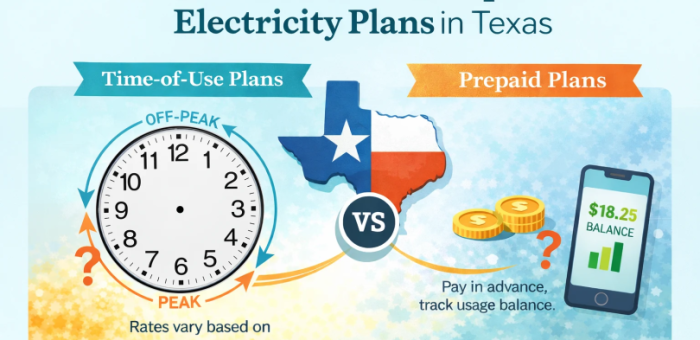
Prepaid and time-of-use (TOU) electricity plans take two very different approaches to rates and plan structure. Each can...
Power Wizard surveyed 2,260 Americans to reveal the states most likely to drive up utility bills and the everyday habits...

Windows can be a major source of energy loss in homes that rely on electric heating and cooling....