
Power Wizard is an independent electricity marketplace offering clear and unbiased information. The companies featured do not influence our editorial process, even when we showcase their products. Check our editorial process and how we make money.
Although Texans in deregulated areas can choose their electricity provider, nobody can choose their Transmission and Distribution Utility (TDU), also known as an electric utility company. TDUs are assigned by location regardless of whether you live in a deregulated city because they own and maintain certain sections of the Texas electric grid.
Electric utilities aren’t always the first thing people think of when it comes to their electricity service, but their regulated fees add to your monthly bill, and you need to know how to contact them during power outages. Power Wizard’s energy experts have explained TDUs and broken down the areas of Texas each utility serves below.
How the Public Utility Commission of Texas (PUCT) Regulates Transmission & Distribution Utilities (TDUs)
Just because most of Texas has a deregulated energy market doesn’t mean electricity service is completely unregulated.
The Public Utility Commission of Texas (PUCT) is the primary state regulator for electricity. It oversees retail electric providers (REPs), regulates TDUs, and enforces customer protection rules. The TDU delivery charges on your monthly bill are reviewed and approved by the PUCT. These fees are regulated and passed through to customers, which means your REP cannot negotiate or discount them.
What ERCOT Does – Grid Operations vs Retail Market Oversight in Texas
The Electric Reliability Council of Texas (ERCOT) manages the flow of electricity to about 90 percent of the state’s electric load. It does not set retail rates, sell electricity plans, or send you a bill. Instead, ERCOT:
- Balances real-time electricity supply and demand
- Manages the wholesale electricity market
- Coordinates grid reliability across participating utilities
In simple terms, ERCOT runs the grid. The PUCT regulates the market.
What Is a Transmission and Distribution Utility (TDU) in Texas?
A Texas electric utility, or TDU, owns and maintains the power lines, poles, transformers, and meters that deliver electricity to your home or business. The TDU restores outages, maintains infrastructure, and charges regulated delivery fees that appear on every electricity bill in its service area.
H3: Transmission & Distribution Utility (TDU) vs Retail Electric Provider (REP) – Key Differences
In Texas, your TDU and your REP serve different roles. The TDU delivers electricity through the poles and wires, maintains the grid, and restores power during outages. The REP sets your energy rate, sends your bill, and manages your contract. You can choose your REP, but your utility is assigned based on your location.
| Utility (TDU) | Electricity Provider (REP) |
|---|---|
| Maintains poles & wires | Sells electricity plans |
| Restores outages | Sets energy rates |
| Charges regulated delivery fees | Sets contract terms |
| Assigned by address | Chosen by customer |
Map of Texas Electric Utility Service Areas (Oncor, CenterPoint, AEP, TNMP, LP&L)
Not sure which TDU your address falls in? Use the interactive map below to find out!
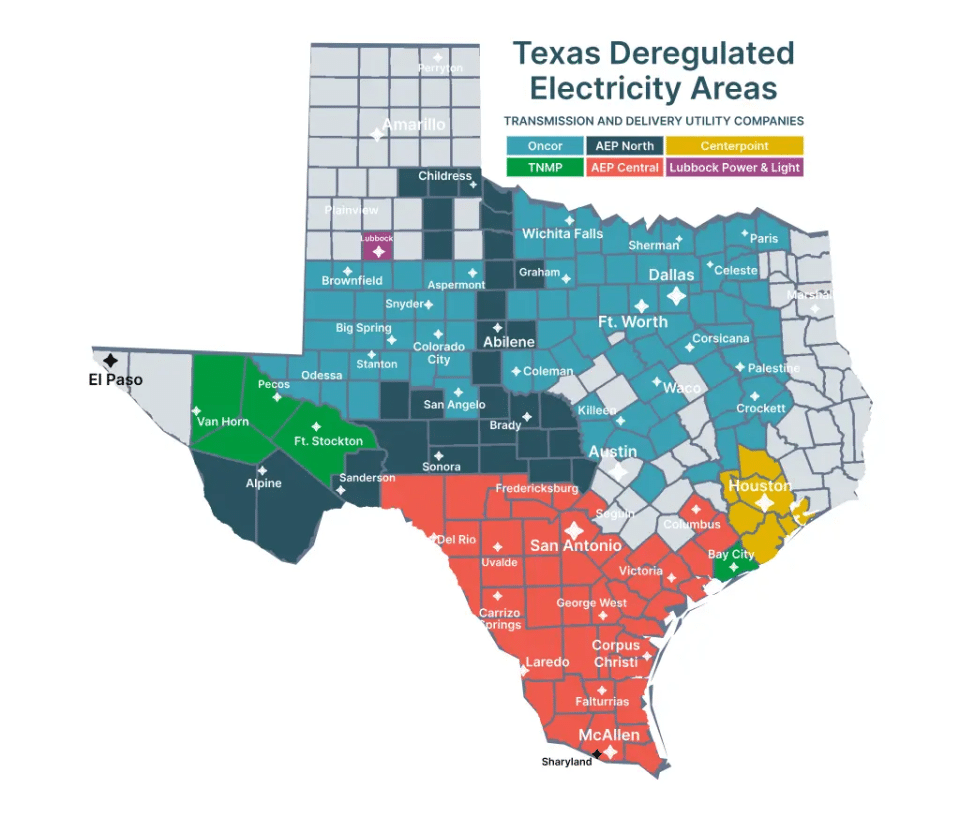
Directory of Texas Transmission & Distribution Utilities (TDUs)
Let’s take a look at the individual electric utilities in Texas.
Oncor Electric Delivery – Service Area, Customers Served, and Infrastructure Overview
Oncor Electric Delivery is the largest electric utility in Texas. It serves more than 13 million Texans across the Dallas-Fort Worth Metroplex and large portions of North, Central, and West Texas. The company manages more than 144,000 miles of distribution and transmission lines.
CenterPoint Energy – Service Area and Grid Investments
CenterPoint Energy delivers electricity to more than 2.9 million metered customers in the Greater Houston area and surrounding Gulf Coast communities. It also offers natural gas services in some areas. Along the Gulf Coast, CenterPoint plays a major role in hurricane response and grid restoration following severe storm events.
AEP Texas North & AEP Texas Central – Service Territories and Load Growth
AEP Texas has two primary divisions: AEP Texas North and AEP Texas Central. Together, they serve over one million customers across a large and diverse territory that includes many rural communities and smaller cities. AEP Texas maintains extensive infrastructure across South, West, and North Texas and provides electric delivery service across wide geographic areas with lower population density.
Texas-New Mexico Power (TNMP) – Non-Contiguous Service Areas Explained
Texas-New Mexico Power serves approximately 270,000 customers across several non-contiguous service areas in Texas. Its territory includes pockets of North Texas, the Gulf Coast, and West Texas. TNMP operates at a smaller scale than the state’s largest utilities but delivers regulated transmission and distribution service within each of its designated areas.
Lubbock Power & Light (LP&L) – Municipal Utility in the ERCOT Market
Lubbock Power & Light is a municipally owned utility that serves customers within the city of Lubbock. Unlike investor-owned utilities, LP&L operates under local governance. In 2024, Lubbock Power & Light completed its transition into the ERCOT market, allowing most local customers to choose a REP while LP&L continues to manage delivery infrastructure.
Texas Utility Outage Phone Numbers and Online Reporting Links by TDU
If your power goes out in Texas, whether you live in a regulated or deregulated city, call your electric utility company. Because they own the grid infrastructure, they can dispatch repair crews and restore power. Each TDU’s contact information is listed below. You can also find it on your monthly bill.
| Utility | Outage Phone | Online Reporting |
|---|---|---|
| Oncor Electric Delivery | 888-313-4747 | https://www.oncor.com/outages/create_outage/identifyReport Outage |
| CenterPoint Energy | 800-752-8036 | https://paslite.centerpointenergy.com/outage/texas |
| AEP Texas | 866-223-8508 | https://www.aeptexas.com/outages/ |
| Texas-New Mexico Power (TNMP) | 888-866-7456 | https://tnmp.ifactornotifi.com/ui/outage-reportingReport Outage |
| Lubbock Power & Light (LP&L) | 806-775-2509 | https://electricoutage.ci.lubbock.tx.us/gridvu/ |
How to Find Your Assigned Texas Utility by Address or ESID Number
Your utility is assigned based on your physical address, not the electricity provider you choose. The fastest way to find your TDU is to use Power Wizard’s ESID lookup tool. Your Electricity Facts Label (EFL) and past electricity bills will also list your assigned utility.
What Are TDU Delivery Charges on a Texas Electricity Bill?
Your utility adds regulated delivery fees, listed as TDU or Transmission and Distribution Service Provider (TDSP) fees, to every electricity bill. These charges cover the cost of maintaining grid infrastructure. The PUCT approves these rates, and REPs pass them through to customers without markup. Delivery charges typically include a fixed monthly fee and a per-kWh usage fee. The PUCT reviews and updates these rates periodically (often multiple times each year) through formal rate cases and cost recovery proceedings.
Are TDU Delivery Charges the Same Across All Electricity Providers?
Yes. Within the same TDU service area, delivery charges are identical across all electricity plans and providers. These charges are set by the local utility (TDU/TDSP) and approved by the Public Utility Commission of Texas (PUCT), so no Retail Electric Provider can discount, waive, or change utility delivery fees.
What can vary by provider is the electricity supply rate (listed as energy charge), plan structure, and any provider-specific fees, which is why total prices can differ even when TDU delivery charges are the same.
TDU Delivery Charges by Texas Utility
As of October 2026
| Utility | TDU Charges per Month (fixed) | TDU Charges per kWh (variable) |
|---|---|---|
| Oncor | $4.06 | $0.0603 |
| CenterPoint Energy | $4.90 | $0.0653 |
| AEP Texas North | $3.24 | $0.0558 |
| AEP Texas Central | $3.24 | $0.0569 |
| Texas-New Mexico Power (TNMP) | $7.56 | $0.0777 |
| LP&L | – | $0.06312 |
Why Texas Transmission & Distribution Charges Are Increasing (2010–2026 Data)
Delivery charges have increased as utilities invest heavily in grid expansion, reliability upgrades, and high-voltage transmission projects. The regulated portion of the average Texas electricity bill has grown from about 28% in 2002 to roughly 39% in 2024. Transmission costs have tripled since 2010, reflecting an inflation-adjusted increase of about 57%. Large infrastructure projects, including 765-kV transmission lines supporting growth in areas like the Permian Basin, could add more than $3 billion annually to the statewide transmission cost of service over time.
Compare Texas Electricity Plans by Utility Service Area
If you live in a deregulated area of Texas, knowing your TDU can help you find the right electricity plan for your home or business. Your TDU’s delivery charges impact your overall bill, so be sure to factor them into your decision.
Ready to start your search? Enter your ZIP code into Power Wizard’s comparison tool today!
Frequently Asked Questions About Texas Electric Utilities and TDUs
Yes, your utility may change if you move to a different city or region of Texas. Utilities are assigned strictly by physical location. If you move across TDU boundaries, you will be served by a different utility.
Yes, your local TDU is responsible for restoring power after storms, hurricanes, or equipment failures. Electricity providers do not handle outage restoration. Always contact your assigned utility to report an outage.
Your electricity provider charges for the energy supply and contract plan. Your utility adds regulated delivery charges for maintaining poles, wires, and infrastructure. Delivery charges are approved by the Public Utility Commission of Texas and are the same regardless of provider.